Showing posts with label Educational. Show all posts

Thursday, August 19, 2010

Now the CRROBS Instructors are the students!

So while all the summer course students return home, with awesome tans, to share photos and stories of their adventures in Costa Rica, and fall students start enthusiastically packing for their upcoming semester and adult courses, CRROBS instructors are not so lucky. They are spending 9 straight days, from August 18-26, getting their Wilderness First Responder (WFR) and Emergency Response Certifications (ERC), here at Base.

Wilderness First Responder, also known as the WFR, is a certification combining the Emergency Response Certification (ERC) with additional hours of curriculum and practical tests in a wilderness setting. The ERC (a 48-hour DOT course certification) is required for police, athletic trainers and firemen in the USA, and it is administered by the American Red Cross (ARC). Due to the remote nature of our courses, our lead field staff are required to have successfully completed the entire WFR and ERC course, every 3 years, as per ARC standards.

At CRROBS, this course lasts nine days-- filled with in-class instruction; case studies; patient care stations; skills assessment; and most importantly, “practical” scenarios and drills. For a complete break-down of the curriculum, please visit this link.


However, this year, we added a few more classes, to the traditional WFR/ERC certification curriculum, to better address our students’ needs and well-being. For example, one of Costa Rica Outward Bound’s core values is social and environmental responsibility. Therefore, All CRROBS instructors attended a lecture, by environmental educator and activist, Federico Solorzano, of Planet Conservation (more about this coming soon!) about to be more eco-sensitive on course, at home and at work.

We also invited Dr. Steven Kogel Hughes, who has been practicing Psychiatry and addiction medicine since 1982, and is the current resident Psychiatrist at Tropical Oasis, to educate all CRROBS staff on mental health issues, diseases, and both natural and pharmaceutical treatments from everything from Attention Deficiency Disorder to Depression to substance abuse issues. These two new classes seek to better prepare all our staff for the general well-being of staff, students and the environment.


Tuesday, May 4, 2010

'Tis the Season to Hear Bugs Hit the Wall


They come in May with the rain.
At times they can drive you insane.
They make a loud buzzing sound,
then hit the wall and the ground,
and this happens over and over again.


Meet: the Abejones de Mayo.

People in the States call them "June bugs."
Scientific circles know their family name to be Scarabaeidae. (You can call them "scarab beetles" for short.)
Ancient Egyptians believed scarab beetles to be sacred.
Their colors range from brown to metallic gold.
They are common in tropical locations.
Costa Rica is home to 70 different species of abejones de mayo.

They come out once a year, and when they do, they are everywhere. They land on our desks at work, hit our bedroom windows, and even run into our heads (probably because they are dizzy after just running into a wall).

Although they are named for the month when the rainy season starts in the Central Valley ("mayo" = "May"), the beetles can be found in Costa Rica most of the year because of the many different climates around the country. And while they are all over the place around May, the adult beetles lay their eggs in the soil where the larva lives. (Unfortunately, the larva eats roots and causes damage to crops and plants.)

"Those laid in May will reach their biggest size in around November to December, when they will undergo a transformation into adulthood that takes around a month. It is then that they stay in a state of immobility until the first rains fall, usually about three months later," says Helen Thompson of A.M. Costa Rica.

Their life cycle lasts about one year. It begins in the soil and ends with a thud.


Sources: Wikipedia, A.M. Costa Rica, The Spencer Entomological Museum, Fundación Cientec, Natural Worlds

Thursday, April 15, 2010

Weeeeeee!

"I love the feeling of soaring through the air."
-2010 student

For some, it's exhilarating. For others, it's their worst fear. Both of these types of people would agree: it's the best way to see the upper canopies of the rainforest.

It's zip-lining.

Regardless of how you feel ascending that mountain, gear in hand, awaiting your flight from tree to tree; it requires no skill. Even the most terrified of heights can make this happen.

Last December I went zip-lining with the person designated "the most terrified of heights" that I know, and she completed it with "flying" colors: all 19 platforms at Adventuras La Carpintera (about 20 minutes away from our base). Amber Woods, age 27 at the time, said,
"It was great once I finally opened my eyes!"

Here's a breakdown of the activity, to put the light-headed at ease:
  1. Apply your harness, stepping into it like you're putting on pants (refer to 1st photo on right to see applied harness)
  2. Apply your helmet (refer to 1st photo on right to see applied helmets)
  3. Apply your leather gloves; one has extra protection because it is used as your "break" when zip-lining (refer to 2nd photo on right)
  4. Walk to the platform
  5. Your guide will attach your pulley to the cable as you help him elevate your body by doing a "pull-up" on the cable (refer to 3rd photo on right)
  6. Your guide faces you forward
  7. You sit in a chair position with legs crossed, body bent into a seated position (4th photo)
  8. Place your left hand on your harness, near your lap (4th and 5th photos)
  9. Place your right hand - the glove with the additional leather - on the cable BEHIND the pulley (4th photo)
  10. Your guide pushes you forward
  11. Pull down on your right hand to slow down (4th and 5th photos)
  12. A bumper and a guide on the next platform stop you if you haven't stopped yourself yet
  13. Enjoy the ride and the view!

And if this still doesn't help you, listen to Amber: "It helps to go with a guide the first couple lines... helps to ease your fears.... You're able to look out into the city and jungle, etc. which is calming.... And since you are clearly harnessed very tightly, the fear starts to subside and you get addicted to the rush of flying through the air."


See zip-liners in action in this video!

Wednesday, April 14, 2010

No Alimentar los Monos

a-li-men-tar /v./ - to feed

All students who pass through our base in Manuel Antonio love to see the surrounding trees filled with titi monkeys swinging from tree to tree in perfect view from our three-story base windows. Students watch them as they wake up and eat breakfast every morning. But they have to keep that breakfast to themselves and out of the hands of those monkeys if they want to help the environment, keep people safe, and keep monkeys safe.

A piece of paper on our base's refigerator lists "10 Reasons You Should Not Feed the Monkeys":

1. The monkeys are very susceptible to diseases transmitted by human hands. Monkeys can die from transferred bacteria.
2. Migration to areas populated by humans (for food) increases the risk of dog attacks and car accidents.
3. Irregular feeding leads to aggressive behavior toward humans and other species.*
4. Contrary to the stereotype, bananas are not the favorite food of wild monkeys. Bananas - especially those containing pesticides - can disrupt the delicate digestive system of monkeys and cause serious dental problems that may eventually lead to death.
5. Feeding the monkeys creates a dangerous dependency on humans that diminishes the survival skills of the monkeys.
6. Feeding the monkeys interferes with the natural habits of the monkeys and alters the balance of their lifestyle centered on eating wild fruits, seeds, small animals and insects.
7. Contact with humans facilitates poaching and illegal wildlife trade.
8. If pregnant monkeys eat only bananas during pregnancy, the baby is at risk of malnourishment. Some never develop to term and die before birth.
9. Monkeys have to travel an average of 17 kilometers each day to be in good physical condition. If they know food is available in a certain place (from people), they do not leave that area and get the exercise they need.
10. Not only can humans transmit diseases to animals when feeding them by hand, but they can pass diseases to humans as well.

*Debbie Mayer, one of the staff members in the communications office, knows #3 quite well. On a trip to the Cahuita National Park earlier this year, she stopped along the path to take pictures of many monkeys in the trees nearby. Suddenly she noticed how close they were getting, just before one jumped onto her tote bag to which she reacted by throwing the bag on the ground. The monkeys then sifted through her bag to find one pineapple slice to eat! (See photo on right) She had to use a stick to get her tote bag back. Apparently, someone had fed these monkeys some of the delicious pineapple - sold at the park's entrance - before.

Think twice the next time you're passing through one of Costa Rica's many national parks and want to share your food with the monkeys; you never know what foods they'll crave later from innocent passers-by.

Wednesday, March 24, 2010

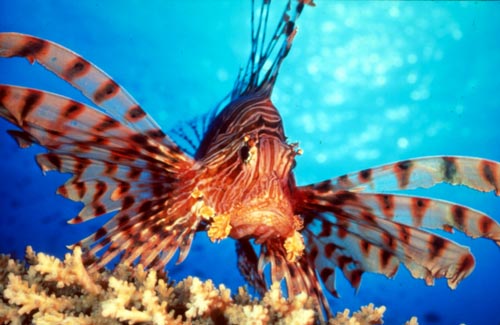
Panama: Lionfish Invasion

One of the most crucial parts of the scuba certification education process is learning about aquatic wildlife.

Why 'crucial?'

Because a human's touch can be fatal to an entire species; and on the flip side, marine life, too, can be fatal for humans.

The lionfish, while not fatal, does fall in the "danger" category, as it is a poisonous aquatic predator with an incredibly painful sting. The sting can last up to two days and cause some swelling. Immediately, the sting can be treated by frequently immersing the affected area in water no warmer than 114 degrees Fahrenheit until symptoms subside.

Because of its deceptive beauty and its large Panamanian population, our scuba dive masters had to draw special attention to its danger when instructing the Water & Wave and Tri-Country students last week - and OB USA this week - in Bocas del Toro, Panama. It was a helpful lesson because they did, in fact, report having swum very closely with the colorful fish.


The large and growing population of this South Pacific and Indian Ocean species has become a major environmental issue, not only in Panama, but in the Caribbean and all the way up the US east coast.

It's invasion in this hemisphere is a unique and interesting story.

In 1992, an aquarium broke during Hurricane Andrew and is believed to have released a few lionfish into the Atlantic Ocean. Since then, reports have begun to come in regularly from divers in Florida, all the way up to Massachusetts, and now all the way down to Panama these past 20 years. (Luckily for the northern states, the species’ intolerance of cold winter temperatures means it is unlikely to survive in these areas.)

This is a problem to the marine environment because lionfish are voracious predators that quickly adapt to eating new types of food, and they have no native predators in Atlantic or Caribbean waters. Lionfish have venomous dorsal, ventral, and anal spines that can deter predators and injure humans. They can reproduce year-round and are relatively resistant to parasites, giving them an advantage over native species. They are also fast growing and can outgrow and out-compete native species for food and space. Lionfish are eating fish, invertebrates and coral in large quantities, including juvenile spiny lobsters, parrotfish, and the Atlantic coral reefs. Reefs depend on some of the decreasing reef species to prevent seaweed and macroalgae from overgrowing the corals.

There is no way to really rid the waters of this species, but different diving groups and governements are playing their own part in trying to alleviate the problems. And actually, while the students were in Panama last week, the local paper published an article educating civilians about lionfish and urging people to kill the predator when they get the chance!

A recent article in Smithsonian Magazine reported, "Some experts believe that lionfish are so widespread that their effect on the ecosystems of the Western Atlantic will be almost impossible to reverse."

Friday, January 22, 2010

Learning to Surf

"It's a lot harder than I thought it would be."

This is one of the most typical comments of feedback we hear from students after their first few days learning how to surf. And after Calvin College students head to Manuel Antonio to learn this weekend, they will most likely be in agreement.

Physical challenges are most commonly faced in three areas:

1. getting out there: this requires paddling, diving under waves, bringing your heavy board with you (voted the most physically challenging by far)
2. catching waves: quick and strong paddling is necessary to stay in front of the wave that pulls the surfer backwards
3. popping up: similar to doing a push-up, but with extra effort to stand up

Almost every week here in Costa Rica, more Outward Bound students are experiencing this surf workout, and luckily they have some veteran surf instructors to help them beef up, get motivated, and physically assist them in the water. One of them, Carlos "Diablos," is shown in this video instructing the Adult Surf Getaway students earlier this month:


Greg, a long-time surfer from California who works in Costa Rica Outward Bound's communications office, has this to say: "It's hard, but it's worth it."

Friday, January 15, 2010

CRROBS Hosts the IRF

SAN JOSE, Costa Rica – October 21, 2009

“Watch out for the eddie line on the other side of that hole once you pass the strainer and the laterals.”

Did you catch any of that? Neither do most people, which is why we leave it up to the rafting professionals.

Fourteen of Central America’s finest rafting gentlemen met for over six hours today to discuss standardization of rafting certification guidelines. Those in attendance were representatives and president (Rafael Gallo) of the International Rafting Federation (IRF), rafting guides and executive director (Bradley Jim Rowe, PhD.) from the Costa Rica Rainforest Outward Bound School (CRROBS), and guides and owners from other major Central American rafting companies.

In the cocina of CRROBS’ San Ramon base (in the outskirts of San Jose, Costa Rica), they presented different rafting issues, including the inconsistencies among different companies’ raft guide instruction. They spent the day reviewing and updating the training, certification and safety procedures among all rafting companies to ensure that all people rafting with IRF-certified professionals get the same safe and exciting experience. “This meeting gave us the chance to see how other guides train instructors for this sport and how we can use these ideas to make all of our systems standard for all rafting groups,” observed Carlos Grenados, a CRROBS rafting instructor from Costa Rica. “It’s really a great thing.”

In addition to standardizing the instruction, another hopeful outcome of these series of seminars is to give the IRF more credibility. All rafting guides will now share how they teach their Swift Water Rescue and Rafting Rescue courses in addition to becoming stricter with the certification process. Instructors will be required to sign off on specific skills, number of days rafting, and experiential tests.

The standard for CRROBS raft training now is a rigorous 20-day instruction which includes four days of Whitewater Rescue Training (WRT) through Rescue III International and 16 days in rivers all over Costa Rica for more extensive training and experience. In addition, CRROBS requires CPR, WFR (Wilderness First Responder), and TRRO certifications. It is for this thorough process why the IRF has sought CRROBS’ involvement in the new structuring of guide regulations.

It meant a lot for the thirteen men in attendance to have IRF’s president, Rafael Gallo, present at the meeting. “Seeing his ambition for improving IRF’s standards and the direction of rafting as a recognized sport really helped motivate us to take some action,” stated Joe Ewing, another CRROBS rafting instructor. Gallo, too, was excited to begin these meetings, saying “We are trying to focus on certifying people as guides because the focus currently is on rafting competitions.” Now it’s getting back to the basics and the important parts of rafting and instruction.

This isn’t to say that rafting competitions are not going to be a focus in the upcoming year. Costa Rica Outward Bound employees are already getting a team together for an IRF competition this coming summer. All CRROBS instructors who attended the seminar – Daniel Jimenez, Felipe Lopez Salazar, Joe Ewing, and Carlos Grenados – left the meeting excited about their strong CRROBS team of rafters.

The next meeting is scheduled for mid-November, again at Costa Rica Outward Bound’s base, to begin to specifically document the standards for raft instruction through which all guides must pass as official IRF instructors.

The International Rafting Federation (IRF) is an assembly of national associations and organizations with the goal of harmoniously developing, organizing and assuring rafting's future and that of international competition. http://www.intraftfed.com

Costa Rica Rainforest Outward Bound School (CRROBS) is an experiential education program designed to inspire and develop leadership, compassion, responsibility, respect for the environment and commitment to serve through adventure-based wilderness experiences in Costa Rica, Nicaragua and Panama.

Monday, October 19, 2009

Backpacking Tips & Tricks: Cooking

If you are a past student, an instructor, or a wilderness enthusiast, you have been in this situation: the fire won't build, and you're hungry. Hopefully, you finally succeeded, or maybe you resulted to eating raw food. In the case of the latter, we have gathered a few tips to help you the next time you are starving in the wilderness.

So here are some helpful tips:

  • Where: on a sandy or rocky area (or near a supply of sand and water so as to avoid forest fires!)
  • Most common mistakes: choosing poor tinder, failing to shield precious matches from the wind and smothering the flames with too-large pieces of fuel
  • Four Key components: spark, tinder, fuel, oxygen
  • How to create a spark: matches, a lighter, flint against steel, electric spark from a battery, or sun rays through a magnifying glass


Or if you are a serious camper ready to make your own stove (and avoid the struggles of building a fire), see this 1.5-minute video for making a do-it-yourself stove out of a can, a tac, a razor, antifreeze, a piece of tape, and a small piece of insulation.

Monday, September 21, 2009

Students Learn to Save Annie


“Annie! Annie! Are you okay?”

Most of us who have ever been in a CPR course are familiar with this emergency questioning. It’s what we say to our appendage-free dummy, nicknamed Annie, when her rubbery plastic face does not respond to our shaking and talking. And when she doesn’t respond to the questioning mentioned above (almost 100% of the time), we have to call for help and begin CPR.

CPR, which stands for Cardiopulmonary Resuscitation, is an important skill for anyone to have. This especially includes Costa Rica Outward Bound semester students, such as those in the Tri-Country course who are getting their certification today. CPR is necessary in order to sustain life in the first critical minutes of cardiac arrest. Luckily (knock on wood), never has anyone had to administer this on one of our Costa Rica Outward Bound courses; but as the old saying goes: it’s better to be safe than sorry. (And on that topic, go to the Instructor Certification page to see how safe and prepared our CRROBS instructors are, “just in case.”)

For those new (or old) to this certification process, here is a standard procedure learned during a CPR certification course.

Assessing the situation
Call for help
A-B-C Checks: Airway, Breathing, Circulation
Chest compressions and breaths

Our Tri-Country students are spending Day #2 in Costa Rica getting this certification today from our CRROBS instructor, Daniel JimĆ©nez Fallas (Danny). They began at 6am, spending the whole day in "class" to learn what it takes to resuscitate a victim in cardiac arrest. This certification lasts for one year – plenty of time to cover their 85-day course.

Monday, September 14, 2009

Cooking With Plantains


Many of our students leave course, wanting to relive their glory days in Costa Rica when they experienced unique activities, connected with the environment, challenged themselves, practiced Spanish, learned new skills, self-evaluated, stayed in shape, and/or ate incredibly tasty and amazing local food.

While we can't provide solutions for every one of these nostalgic desires, we can at least help alleviate the memory-lane strain. One way of doing this is helping you cook some of the local food at home for yourself and your family/friends.

The first Tico food item you can easily learn to prepare?

Plantains.

There are two very common - and easy - snacks/desserts to make from plantains: maduros y patacones.

Differences: Patacones (shown in the photo above) are in the shape of a sand dollar made with unripened green plantains, and maduros are ripe plantains cut long-ways. Patacones are on the salty side, and maduros are on the sweeter side.

For a recipe to patacones, go to our newsletter article by clicking here.

For a recipe to maduros, here are the instructions:
INGREDIENTS: ripe plantains, brown sugar, cinnemon, frying oil
PREPARATION: slice plantains long-ways into thin strips, heat up a frying pan with a layer of oil in it
COOKING: fry slices of plantain in the oil, sprinkling brown sugar and cinnemon to taste; fry until browned

So go out and find some plantains to fry. If you request more recipes from your experience here, please 1) request them on our Facebook fan page wall at http://www.facebook.com/crrobs, 2) go to our newsletter archive (each one has a Tico recipe), or 3) send an email to crrobs@gmail.com for a specific request.

¡Buen provecho!*

*a Tico phrase used before meals with the same meaning as the common French phrase "Bon appetit!

Thursday, July 23, 2009

Girl Scouts Make Tamales

Yesterday was the longest these 13-14-year-olds had ever spent cooking, preparing, and waiting for dinner. That's what happens when your meal of choice is the Costa Rican tamale.

We didn't know what time it was (because Outward Bound's policy is that no student wear a watch), but most of the day was devoted to tamale activity:
  • Morning (after breakfast): used machetes and knives to cut big, broad leaves from banana trees
  • Afternoon, hour #1: boiled meat; cut up banana leaves into long strips; used meat broth to make the corn meal paste; boiled rice; prepared fire to boil leaves in large pot
  • Afternoon, hour #2: rolled and tied banana leaves; boiled rolled leaves for one hour
  • Afternoon, hour #3: cleaned and cut potatoes, red peppers, carrots, and cilantro
  • Before dusk: removed banana leaves from pot, untied them, unrolled them, and dried them; rolled corn meal paste into balls
  • Dusk: on criss-crossing banana strips, smushed one ball of corn meal; layed meat, rice, and vegetables on banana leaves; folded leaves corner-to-corner and tied rope around each tamale
  • Evening: boiled tamales for two hours
  • Night: opened tamales to let cool for fifteen minutes; then eat! Buen provecho!


The girls had a great time interacting with our local Tico neighbors who taught them how to do every step of the process (in Spanish). By the way the girls chowed down on the tamales, we'd have to call it a success.

Wednesday, July 15, 2009

Hands-On Spanish

Learning Spanish while zip-lining? Rafting? Surfing? Hiking? Rappelling? Kayaking?

Spanish is getting to be a little more fun to learn.

Costa Rica Outward Bound created a 30-day Spanish Emphasis course after more and more Spanish high school and college classes (and individual Spanish students) signed up for CRROBS courses to be immersed in the language and culture. Tico instructors provide day-to-day conversation and lessons, and students spend quality time with families at the homestays. The next course begins July 23rd, and we are still getting new applicants.

Milandra, a student from last year's Spanish Emphasis course said:

"I felt like a sponge the entire course; soaking up the beauty of the culture and country, learning Spanish and learning about myself. I don't want to go home. I realized how little is required to be happy. Living so simply was eye-opening, and in the end, much more rewarding. It's different from any "camp" you will ever participate in; these are once-in-a-lifetime experiences that will stay with you and contribute to your life."

If you want to read more about the Spanish Emphasis itinerary, costs, and benefits, click here: http://www.crrobs.org/courses/itineraries_summer_spanish_emphasis.html, but keep in mind the next course starts July 23rd.

Friday, June 19, 2009

Grigri? Handog? Gumby? Chock? Huh?

If you don't know what these are, ask a Girl Scout. They're at the climbing wall today learning terms such as these, before helping other Costa Rican Girl Scouts this weekend. After today's long training session, they would tell you:

grigri (n.) - A belay device designed to be easy to use and safer for beginners because it is self-locking under load.
handog (n.) - While lead climbing or on top rope, to hang on the rope or a piece of protection for a rest.
gumby (n.) - An inexperienced (or unsafe) climber.
chock (n.) - A mechanical device, or a wedge, used as anchors in cracks.

I can't take credit for knowing all of these terms, either. Because even while working at CRROBS, it can be difficult learning the technicalities of every outdoor sport we have. If you want to brush up on your terms and win a game of "Are You Smarter Than a Girl Scouter", try Wikipedia.


Wednesday, May 6, 2009

NAUI Scuba Certification

This week two of our courses, Leadership and Tri-Country, are in Panama getting SCUBA certified by our very own Executive Director, Jim Rowe, PhD.

So what does it take to get SCUBA certified, you might ask (especially if you're a parent, wondering what your child must go through in order to get such a gold stamp)?

First of all, all of our students' certifications are backed by NAUI (National Association of Underwater Instructors) Worldwide, the world's most respected, largest non-profit diver training organization in the world. It was established in 1959 as a membership association and organized solely to support and promote Dive Safety Through Education.

The course lasts 3-5 days, and it looks like this:

* Contained Dive: This usually happens in a pool or very shallow water to practice standard rhythmic breathing and buddy breathing.
* Open Dive #1: Students descend in water approximately 10-20 feet for 45+ minutes or more, always with an instructor. They must apply a few practical emergency skills, such as mask clear and retrieval of regulator. Hand signals are also practiced.
* Open Dive #2: Students again descend in water with their instructor about 10-20 feet for 45+ minutes. Practical challenges consist of Dive #1 tests in addition to a few more.
* Open Dive #3: Students descend for another 45+ minutes with their instructor, this time about 20-30 feet. Practical challenges include those of Dive #1 and #2, and the instructor will add a few more, such as equipment removal and reapplication.
* Open Dive #4: This is the final 45-minute dive with their instructor, and students must quickly be able complete all practical challenges as well as troubleshoot fake emergency situations.
* Free Dive: Students are allowed to explore always within sight of instructor.

And lastly, SCUBA - for your trivia lesson of the day - means Self-Contained Underwater Breathing Apparatus.

Friday, April 10, 2009

Dyeing My Clothes in the Wild

Okay, so appearance doesn’t really matter after your clothes have become caked in mud and covered grass stains, you have begun to smell like a moldy rag, your skin is a darker shade (from dirt, not sun), and your hair no longer resembles that of a human. But, let’s say, near the end of your trip, you would like to wear your permanently-stained clothes in public. This is what happened to me after a hike, and I told some friends that I wanted to dye my favorite sweatshirt. “Oh! Here! Take my indigo plant! If you really want to dye it, this will never come out,” was my friend’s response. I had no idea what she was talking about, and then she pulled an indigo plant out of her backpack after returning from a course. I held it in my hand, wondering how to properly use it before turning my skin the color of Violet Beauregarde’s in the “blueberry scene” of Charlie and the Chocolate Factory.

After a little research, I learned a few things:

-Natural indigo was the only source of dye until July 1897

-Indigo is the primary dye used in blue jeans

-Indigo is also used as a food coloring

-Indigo is hard to use because it is not soluble in water; to be dissolved, it must undergo a chemical change. When a submerged fabric is removed from the dyebath, the indigo quickly combines with oxygen in the air and reverts to its insoluble form

Therefore, to use it, follow these instructions

  1. Fill a pot with about 1 liter of urine – yes, urine - or water (with water, it’ll fade, but with urine it will create a more permanent dye)
  2. If you dare to use urine, cover the pot with a secure lid and let it ferment for 6 weeks in a warm place
  3. Cut up the leaves and berries into pieces (about 1/5 kg of it), and stir it into the pot
  4. Let it sit for 3-4 days (in either urine or water)
  5. Put cotton inside pot for a few days (the longer it sits, the deeper the color)
  6. RINSE, RINSE, RINSE.

Bottom line: dyeing your clothes naturally can be a dangerous and smelly process. But it’s a great story.

Monday, March 23, 2009

Spanglish: Me Encanta Espangyol

Six years of Spanish classes, visits to Spain and Mexico, and perfecting my paella recipe did not prepare me for conversational life in Costa Rica. Nearly a year ago when I landed on the CRROBS base I was lucky that I could even utter hola with the proper pronunciation instead of greeting someone with the famed “holla.”

I would stand in silence surrounded by Lopezes speaking at me in Spanish and respond with looks of sheer horror or an occasional head nod that really meant nothing. From that point on, I not only knew that I needed to learn what they were saying, but I also wanted to learn.

Learning a language has never proven easy for me, so my best way to go about this was by making words up. I began by using the same Spanish verbs repeatedly to form random sentences (querer (to want) and poder (to be able)…you know the drill) intertwined with English words pronounced like Spanish words. Some of them had to be real words…right?!

That was, until the trobulo incident. We all know how common it is to use the phrase “I’m in trouble” about an array of topics in the states and I wanted to be able to say it in Spanish. Instead of making the word up I decided to ask a friend and was told that the word for trouble was trobulo. So I walked around base for a week saying esoty en trobulo numerous times to several people and didn’t really acknowledge the smirks or giggles, until one day, a nice Tica told me that trobulo was not a word, not even close. And my “friend” had actually wanted to mess with me and teach me an underlying lesson that I should use the resources around me (converse with Ticos, go to classes, look in the Spanish/English dictionary) rather than make up my own language.

It was the push I needed to actually learn real Spanish from real Costa Ricans. Now rather than staring at the Lopezes blankly I can joke around with them like family. Que suerte.

But, don’t get me wrong, I still love my Spanglish.

Monday, March 9, 2009

Living with a Mestizo?


Many of us did a "homestay" at a "Mestizo" village. But most of us did not know what that meant until we got there. Now we understand that a "homestay" is staying with a local family to better learn the local lifestyle. And "Mestizo" is a term for a culture of people in Latin America who come from a combination of European, American, and Indian ancestry. Actually, about 94% of the Costa Rica population is Mestizo/white combination! Another word we heard a lot was "indigenous" culture (referring to the Mestizo people), and we found out that it is a way to describe the original settlers in an area. The best part about learning all of this was that we were not in a classroom. The knowledge came from hiking there, meeting the families, helping them on the farm, playing on their land (in the river, down the waterfall, or on the soccer field), cooking the food, and sharing language. Your perspective changes a bit when you come from a city where you can ride to the grocery store in a few minutes to grab a snack, then go to a village where it takes 2 hours by jeep then 3 hours on foot. You think twice before you say "I want some milk." But you definitely appreciate that milk more after you slaved for hours to acquire a few drops of milk from a cow (while the indigenous people squeeze out a bucket-full in no time). Maybe my lack of skill came from the 4:30am rooster wake-up calls. There's no room for exhaustion when you have clothes to clean, waterfalls to repel, sugar cane to cut and carry, and rivers to swim. Mestizos make it look too easy.